Steel Demo
& Tank
Specialists
Residential and commercial boiler removal, oil tank removal and abandonment, and steel demolition across Long Island. Family owned. Free estimates.
Our Services
Four kinds of work, residential and commercial, across Long Island. We take things out. We don't put things in.
Oil Tank Removal
Basement, garage, outdoor, and buried tanks. We pump out what's left, take the tank out, haul it away, and file the paperwork with the county.
Tank Abandonment
Closing a buried tank in place: cut open, pumped out, and filled with sand. A proper, documented closure, and an option whether or not removal is easy. We handle all the paperwork and filing.
Boiler Removal
Old cast iron and steel boilers out of basements and boiler rooms, residential and commercial. Your installer puts the new one in. We take the old one out.
Steel Demolition
Structural and miscellaneous steel cut apart, carried out, and hauled away. Heavy, rusted, and awkward jobs included.
What We Do. What We Don't.
Knowing who does what saves you phone calls. Here's our line.
We do
- Oil tank removalBasement, garage, outdoor, and buried tanks
- Oil tank abandonmentClosing a buried tank in place
- Boiler removalResidential and commercial, cast iron and steel
- Steel demolitionCut apart, carried out, hauled away
We don't
- Install tanks or boilersThat's your plumber or heating contractor. We work alongside them.
- Environmental cleanup or soil remediationThat's an environmental firm, and you choose which one.
- Asbestos abatement ourselvesIf we find or suspect asbestos, we can bring a licensed asbestos abatement contractor onto the job.
We have no reason to find a problem
The worry we hear most about tank work is the quote that balloons once the tank is out and somebody "finds contamination." We don't sell cleanup. There's nothing in it for us if your tank leaked.
If there is evidence of a leak, the county inspector sees it and makes the call on whether the DEC gets involved. We don't do cleanup. We'll tell you what the county said and what the next step is. Our job is the tank.
Three Steps
No sales pitch. You tell us what you've got, we tell you what it costs, and then we do the work.
Call, email, or send a request
Tell us what you've got and where it is. Photos help a lot. Use the estimate form to send them.
Free estimate
We look at the job, in person or from your photos, and call you with a price. No obligation.
The work, then the paperwork
Most jobs take less than a day; removals can take longer. The tank or boiler comes out and the site is cleaned up. For tank work, we file everything with the county and you get a receipt showing it was filed.
What Happens on the Job
A buried oil tank gets closed one of two ways: it comes out, or it stays in the ground filled with sand. Here's what each one looks like.
How a tank removal works
The buried tank comes out of the ground and gets hauled away. Nothing is left behind.
 Step 1
Mark the utilities
Underground utility lines are marked before any digging starts.
 Step 2
Dig down and uncover it
We dig down and uncover the whole tank.
 Step 3
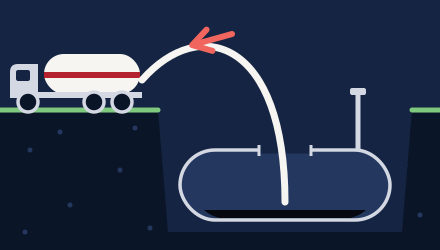
Pump it out
Everything inside is pumped out. A certified oil recycling company takes the old oil.
 Step 4
Lift it out
The tank is lifted out of the hole and hauled away.
 Step 5
Backfill the hole
The hole is filled back in.
 Step 6
Restore the surface
Grass or dirt is restored. If the tank was under a driveway, the driveway is patched.
 Step 7
Paperwork filed
E.D. King Inc takes care of all the paperwork and filing with the county. You get a receipt.
How a tank abandonment works
The buried tank stays in the ground, emptied and filled solid with sand. Most abandonments take less than a day.
 Step 1
Dig down to the tank
We open the ground just enough to reach the top of the tank.
 Step 2
Cut it open
A reciprocating saw cuts an opening in the top of the tank.
 Step 3
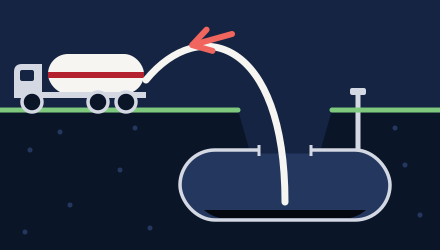
Pump it out
Everything inside is pumped out. A certified oil recycling company takes the old oil.
 Step 4
Fill it with sand
The empty tank is filled solid with sand, so there is no hollow space left underground.
 Step 5
Cover it back up
The hole is filled back in and the surface is restored.
 Step 6
Paperwork filed
E.D. King Inc takes care of all the paperwork and filing with the county. You get a receipt.
A Real Local Company
A family business out of West Hempstead since 1986. Real name, real phone number, real people on the job.
Service Area
Serving all of Long Island, residential and commercial. Based in West Hempstead.
Nassau County
- West Hempstead
- Hempstead
- Garden City
- Valley Stream
- Rockville Centre
- Lynbrook
- Baldwin
- Freeport
- Long Beach
- Mineola
- Westbury
- Hicksville
- Uniondale
- Elmont
- Franklin Square
- & More
Suffolk County
- Babylon
- Amityville
- Huntington
- Brentwood
- Bay Shore
- Islip
- Patchogue
- Hauppauge
- Smithtown
- Commack
- Copiague
- Lindenhurst
- Deer Park
- & More
Free Estimate
No obligation. Tell us what you've got and we'll call you back. Want to add photos? Use the full estimate form.